Most rental cars in Japan are supplied with a full tank and must be returned full. If you return without refuelling, most of the companies below calculate a charge from the distance driven. Guts uses fixed amounts based on the fuel gauge instead.
This guide compares Toyota, Nippon, Times, Orix, Nissan, JR Eki, Sky, Nico Nico and Guts, using their October 26, 2026 guidance with selected fuel and return conditions rechecked on November 1. Confirm any special fuel arrangement with the pickup branch before relying on it.
Nine companies: full-tank returns and fuel settlement
| Company | Refuelling before return | If the tank is not full |
|---|---|---|
| Toyota Rent a Car | Fill up at a nearby petrol station before returning | For non-hybrids: distance driven ÷ the company's model-specific actual fuel-economy figure × the branch's fuel price. Receipted fuel bought during the rental is deducted. Fuel charges are not discountable |
| Nippon Rent-A-Car | Return full using the fuel specified by the vehicle manufacturer | A distance-based conversion charge or a calculation from the gauge reading; more expensive than buying the fuel yourself |
| Times Car Rental | Fill up near the return branch and show the receipt | A refuelling-service charge based on distance; the published calculation is explained below |
| Orix Rent a Car | Return petrol, diesel and hybrid cars full | The company's conversion table is applied to the distance driven |
| Nissan Rent a Car | Return full and show the fuel receipt | Distance driven multiplied by the company's per-kilometre rate; more expensive than refuelling yourself |
| JR Eki Rent-a-Car | Return with a full tank | Its prescribed fuel charge based on distance driven |
| Sky Rent a Car | Use the petrol station nearest the return branch | Distance-based settlement, with the rate varying by vehicle and region |
| Nico Nico Rent a Car | Return full; show a receipt if you refuelled anywhere other than the return branch | A vehicle-specific conversion table applied to the distance driven |
| Guts Rent a Car | Return full; use the designated petrol station where the branch specifies one and show the final fuel receipt | Kei cars: ¥3,300 at “half or more”, ¥6,600 at “half or less”. Ordinary cars: ¥4,950 and ¥9,900 respectively, including tax. The wording overlaps at exactly half; confirm that boundary with the branch |
All nine use full-to-full as the general rule. Exceptions include Toyota's hybrid fuel settlement and selected Sky plans. The first eight companies have a distance-based method; Nippon can also use the remaining gauge level. Guts' fixed-charge method is different.
Nippon and Nissan explicitly warn that their settlement costs more than the fuel you would buy yourself. JR Eki also warns that its prescribed fuel charge exceeds market prices. Ask for the applicable rate before deciding to skip the petrol station.
How Times calculates its refuelling charge
Times' Japanese fee guide gives this basis, excluding remote islands:
- Fuel price per litre = the Oil Information Center's average price + ¥10.
- Charge per kilometre = that fuel price ÷ (the Ministry of Land, Infrastructure, Transport and Tourism's model-specific fuel-economy figure × 0.7).
Multiplying the published fuel-economy figure by 0.7 reduces the kilometres per litre used in the calculation. The fuel-price input changes with market prices. This is a calculation method, not a fixed quote for every car or an assumption that an overseas package uses identical terms.
Cars and plans that do not require a full-tank return
Toyota's Japanese guide offers hybrid fuel settlement based on the distance driven and the average fuel economy displayed in the car. The fuel price varies by branch. This removes the need to fill up immediately before return when the arrangement applies.
Toyota's English first-time-user guide gives the general instruction to return full. If you booked through its overseas channel, ask the branch to confirm hybrid settlement and its calculation before choosing it. A hybrid booking alone does not establish that arrangement.
Sky has selected plans that waive the full-tank return requirement. Check that your confirmation includes one. Orix explicitly includes hybrids in its full-tank rule, including in its English payment guide.
How to refuel before returning
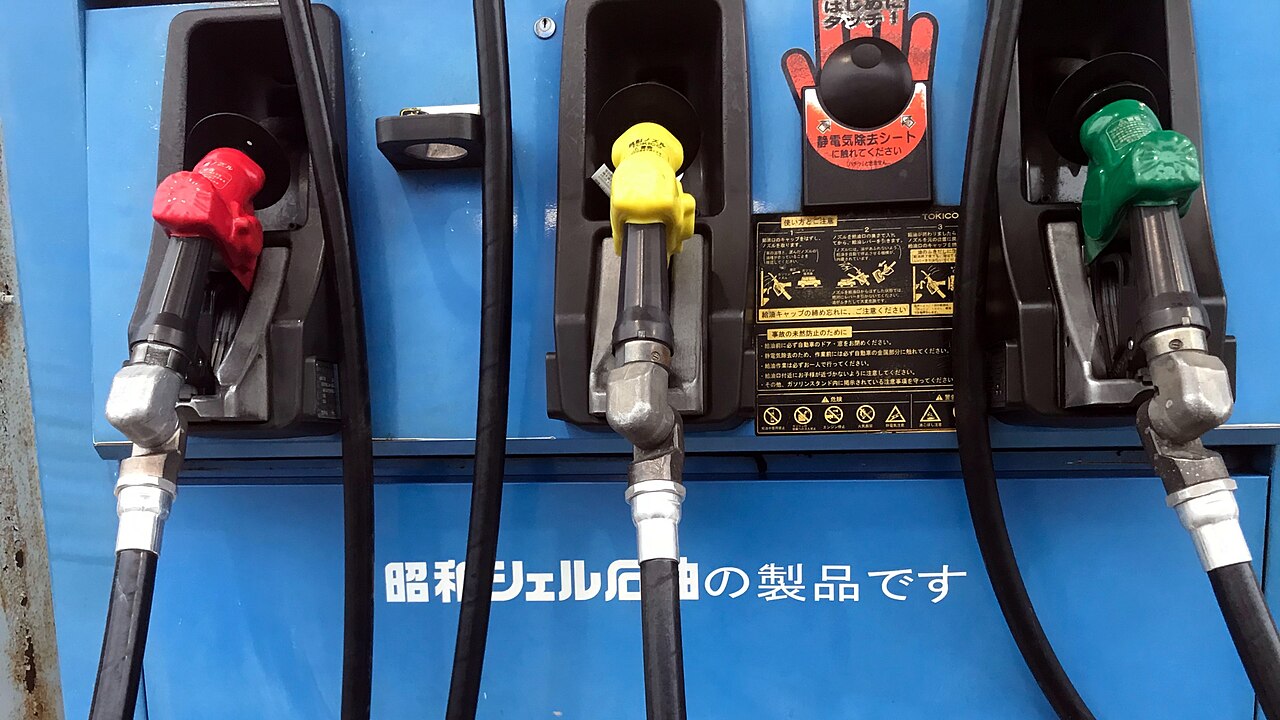
- At pickup, check the fuel-type label on the filler cap or flap. In Japan, the pump colours are red for regular petrol, yellow for premium petrol and green for diesel. Match the actual fuel designation as well as the colour; ask the branch if you are unsure.
- Use a station close to the return branch. Toyota directs customers to a nearby station, Sky to the nearest one, and Times to a station around the branch. Some Guts branches specify a particular station.
- For petrol, stop when the nozzle clicks off automatically; do not keep topping up. Times separately notes that a diesel tank may not read full at the first automatic stop and instructs customers to check the gauge. For a diesel rental, ask the station attendant to follow the vehicle and rental company's filling instructions rather than applying the petrol instruction without checking.
- Take the receipt and show it at return. Nissan, Times and Guts require a fuel receipt. Nico Nico requires one when the fuel was purchased away from the return branch.
Some Nico Nico locations can refuel the vehicle at the branch when you return it. Confirm that service at your particular location.
Wrong fuel and missing receipts
If you put in the wrong fuel
Times makes the renter responsible for the full repair cost of a wrong-fuel incident and asks customers to avoid self-service stations where possible. Nissan also excludes repairs caused by the wrong fuel from its insurance and protection arrangements, leaving the actual cost to the renter.
If you realise you have selected the wrong fuel, stop refuelling, leave the engine off and notify the petrol-station staff and rental company before attempting to drive. Obtain their instructions for the vehicle.
If you lose the receipt
Under Nico Nico's terms, if you cannot show proof of refuelling, the company checks the tank using the vehicle's gauge or other instruments. A missing receipt does not itself establish that the tank is full.
Toyota's non-hybrid settlement deducts the amount shown on receipts for fuel bought during the rental. Keep those receipts; without evidence of the purchase, do not assume that amount will be deducted.
Frequently asked questions
How much does it cost to return without a full tank?
Guts lists ¥3,300 or ¥6,600 for kei cars and ¥4,950 or ¥9,900 for ordinary cars, depending on the gauge level. Its published “half or more” and “half or less” descriptions overlap at exactly half, so ask the branch which applies there.
The other eight companies have distance-based methods, with rates depending on the vehicle or branch; Nippon may alternatively use the gauge. Nippon and Nissan state that paying the settlement is more expensive than refuelling yourself.
Must I refuel after only a short drive?
The general requirement is still a full tank. An approved Toyota hybrid settlement or eligible Sky plan can be an exception.
A distance-based settlement charges for the distance driven. Guts' listed fixed charge is ¥3,300 for a kei car or ¥4,950 for an ordinary car in its upper gauge band, even when more than half remains and the tank is not full.
Do hybrid cars also need to be returned full?
Orix requires a full tank for hybrids. Toyota offers the hybrid settlement described above; confirm that it applies to your branch and reservation before returning without filling up.
Can I use receipts from fuel bought earlier in the rental?
Toyota's non-hybrid calculation deducts the receipted amount of fuel bought during the rental if you return without a full tank. That deduction is not a general permission to replace the final full-tank return with an earlier receipt at every rental company.
Related guides
Sources & verification
Last verified: 2026-10-26
- Toyota: return procedure (Japanese) · 2026-10-26
- Toyota: fuel and hybrid settlement (Japanese) · 2026-11-01
- Toyota: during-rental FAQ (Japanese) · 2026-10-26
- Nippon: during-rental FAQ and fuel (Japanese) · 2026-11-01
- Times: return procedure (Japanese) · 2026-10-26
- Times: payment and fuel rules (Japanese) · 2026-11-01
- Times: refuelling-service calculation (Japanese) · 2026-11-01
- Times: returning without a full tank (Japanese) · 2026-10-26
- Orix: payment and fuel (Japanese) · 2026-10-26
- Nissan: FAQ (Japanese) · 2026-10-26
- JR Eki: return procedure (Japanese) · 2026-11-01
- JR Eki: refuelling procedure (Japanese) · 2026-11-01
- Sky: pickup and return guide (Japanese) · 2026-11-01
- Sky: FAQ (Japanese) · 2026-10-26
- Nico Nico: rental and return process (Japanese) · 2026-11-01
- Nico Nico: rental terms and fuel (Japanese) · 2026-11-01
- Guts: pickup and return FAQ (Japanese) · 2026-10-26
- Nissan: use, fuel and protection guide (Japanese) · 2026-11-01
- Toyota: English first-time-user and return guide · 2026-11-01
- Nippon: English usage guide and fuel settlement · 2026-11-01
- Orix: English payment and fuel guide · 2026-11-01
- JAF: what to do after putting in the wrong fuel (Japanese) · 2026-11-01